
Bledsoe Projected and Actual Release
Tennessee records contain several dates that answer different questions. The Release Eligibility Date, or RED, is the earliest point when an eligible person may be considered for parole under the controlling law. It is not an exit date. A parole hearing date marks a scheduled proceeding. A Board grant date records a decision, yet release-plan approval or other conditions may still remain. Sentence expiration is the calculated end of the sentence, while actual release or parole date marks the move out of physical custody. Discharge can occur later, when supervision ends.
A pretrial detainee at Bledsoe County Jail usually has no computed sentence-release date. The person may leave after bond, dismissal, or another court order, or may transfer into TDOC custody after a felony judgment. The sheriff's jail register and movement record establish what the jail processed. The court order supplies the authority. A state prisoner at Bledsoe County Correctional Complex follows TDOC sentence and release records instead.
Movement also matters. Leaving BCCX for another TDOC prison is a transfer. Closing a county booking because another agency assumes custody does not mean community release. Read the custodian, location, status, and destination together.
Find Bledsoe Projected Release Dates
Start with the custody system. The TDOC FOIL landing page explains that FOIL covers current and former felony offenders in TDOC custody or supervision. The direct search accepts a name, TDOC or TOMIS ID, or state ID and uses a case-sensitive CAPTCHA. Its public fields may include status, location, offense, sentence, hearing, and release information. Preserve the exact date label shown rather than renaming every field “projected release.”
Use this sequence for a Bledsoe County projected release inquiry:
- Identify whether the person is in Bledsoe County Jail, BCCX, another TDOC prison, federal custody, or no current custody.
- For a TDOC felony record, search FOIL and match identifiers, offense, sentence, location, and status.
- Write down the exact displayed terms, such as RED, hearing information, expiration, or release information, plus the page's source date.
- Send a TDOC Sentence Information inquiry when the public display is unclear or the calculation needs official confirmation.
- For a local sentence, request the judgment, jail-credit terms, and any existing trusty or time-labor record from the court and sheriff.
- After the expected event, confirm actual release through the originating custodian's release record.
TDOC provides distinct sentence-inquiry routes for a state prisoner and for a felony offender physically housed in a county jail. Select Offender Information, then Sentence Information for state custody. Use Offender Information, County Jail, then Sentence Information when a felony sentence is held locally. Tennessee can make TDOC the official timekeeper even while a sentenced person remains in county jail.
The official TDOC Sentence Information page shows those separate inquiry paths.
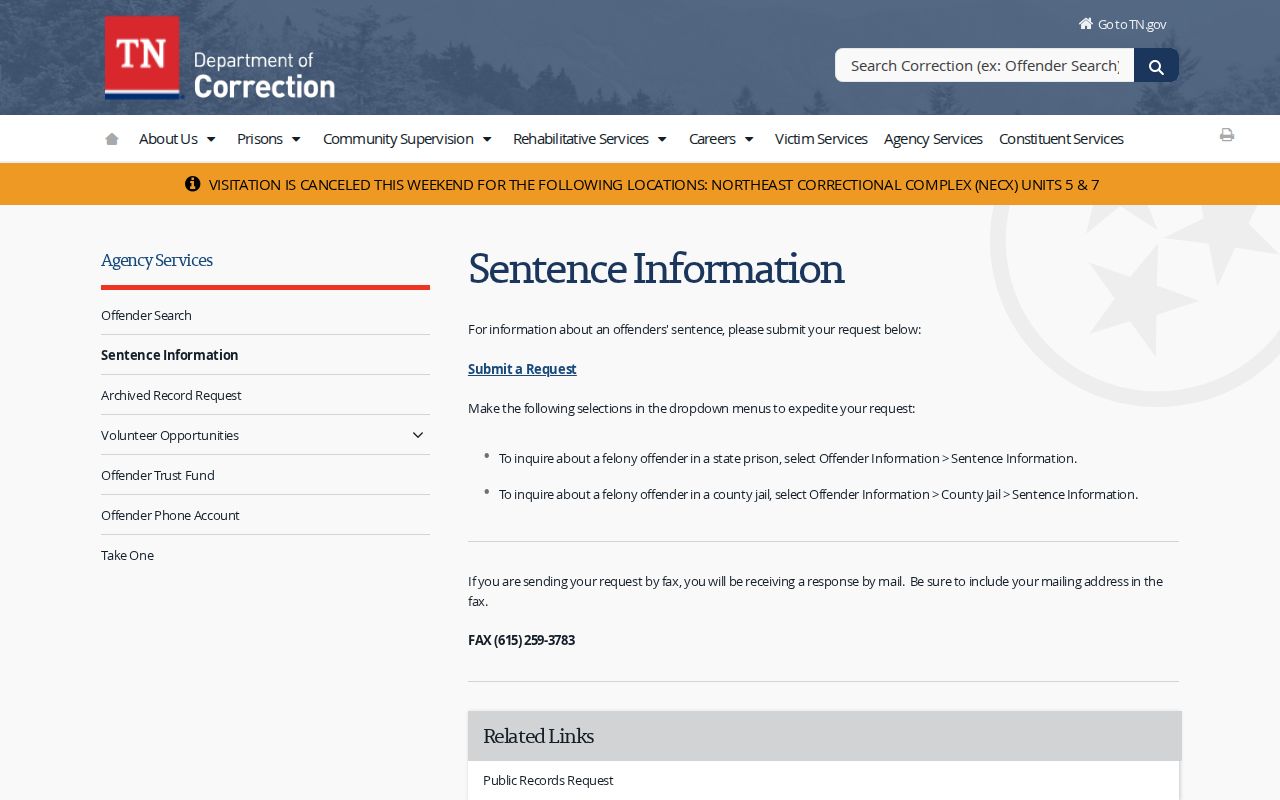
The state and county-jail choices prevent a local jail sentence from being mistaken for an ordinary state-prison lookup.
Bledsoe Release Eligibility Date Explained
RED is the key Tennessee term, but it is often misunderstood. TDOC classifies the sentence and determines the first statutory point at which parole may be considered. The calculation can depend on the offense, offense date, judgment, sentence class, consecutive or concurrent structure, jail credit, and the precise provision of Tennessee Code section 40-35-501. Eligibility creates an opportunity for review. It creates no right to release.
The sequence is longer than one date: TDOC calculates eligibility, the Board schedules a hearing, a hearing officer makes a recommendation, the required Board members reach a final decision, conditions and the release plan are reviewed, and only then may physical release occur. A pre-parole rescission can cancel a grant before departure. A scheduled hearing at BCCX may involve a person from any county because that prison serves a statewide intake role.
Board schedules are updated weekly, but that cadence does not make them release calendars. Hearing types include grant, revocation, custodial, rescission, and time-setting matters. A recommendation remains nonbinding until the required Board action occurs. If the final decision is not clear from FOIL, request the vote and hearing disposition through the Board's public-records process. That record still must be paired with TDOC's later physical-release information.
When FOIL presents an “inactive” status, read the release details before drawing a conclusion. Inactive often means no active TDOC custody or supervision, but it does not by itself give the reason or actual date. A final TDOC release or discharge record is stronger proof.
Bledsoe Release Credits and Sentences
Tennessee Code section 41-21-236 governs prisoner sentence-reduction credits, while TDOC policy applies the rules to eligible state prisoners. Credits are earned privileges, not a flat deduction. Research from the TDOC handbook describes behavior credits during months without a disciplinary conviction, program credits for qualifying work or education, possible bonus credits in minimum custody, and certain one-time educational or treatment achievements. Eligibility and actual award remain controlled by law, policy, and the individual record.
The handbook describes four behavior-credit days per month in the first calendar year without a disciplinary conviction and six per month after that. Up to six program-credit days per month may be available for full-time qualifying activity. Minimum-custody prisoners may qualify for two bonus behavior and two bonus program days per month. Certain educational or intensive residential treatment achievements can yield one-time 60-day credits. These figures cannot be applied as a simple calculator because sentence type, offense rules, award history, and sanctions still control.
There is no universal Tennessee “serve 85 percent” rule. Some older violent-offense or life-sentence provisions use an 85 percent floor or cap reductions at 15 percent. Other subsections use different thresholds. Certain listed offenses committed on or after July 1, 2022, may require 100 percent service under the applicable truth-in-sentencing provisions, with credits operating differently. The judgment and current statute must be checked before any estimate is made.
County sentences require another caution. TDOC prison credit tables should not be imposed on a local misdemeanor sentence. Ask the Bledsoe County sheriff and sentencing court for the judgment, jail credits, and any existing trusty or time-labor sentence-reduction record. The CTAS retention schedule assigns those county records a ten-year period.
Jail credit is also distinct from future earned credit. A judgment may award credit for time already spent in custody, while behavior and program credits depend on later eligibility and conduct. Consecutive sentences run one after another; concurrent sentences overlap to the extent ordered. These structures can change the total term even when each count looks simple alone. The filed judgments and TDOC computation must settle the combination.
Why Bledsoe Release Dates Change
A date can move because its inputs or legal setting change. Some changes affect eligibility. Others leave the sentence calculation intact but delay physical release or redirect the person to another custodian.
| Factor | Possible effect | Best confirmation |
|---|---|---|
| Credit earned | May advance an eligible calculation under current law and policy | TDOC Sentence Information |
| Disciplinary credit loss | Can move RED later when sanctions exceed available credits | Sentence computation and disciplinary record |
| Amended court order | May alter sentence structure or jail credit | Filed judgment or amended order |
| Consecutive sentences | Can extend the combined term | Judgments and TDOC calculation |
| Parole denial or deferral | Leaves custody in place beyond the eligibility review | Final Board decision |
| Release-plan conditions | Can delay departure after a grant | Board and TDOC release record |
| Detainer or hold | May shift the destination to another authority | Movement and receiving-agency records |
TDOC disciplinary policy supplies a concrete example. If a post-1986 prisoner's credit sanction is greater than the credits available, Sentence Computation Services may extend RED by the exact uncovered amount. That is why a date saved from an older screen should be treated as dated evidence, not a permanent promise.
A detainer changes destination more often than it changes the sentence end itself. When another county, state, federal, or immigration authority has a valid hold, the person may leave TDOC or county custody only to enter the receiving agency's custody. A release screen must therefore be checked against the movement record. “No longer here” is not the same as “free in the community.”
Bledsoe RED Is Not Release
The local search phrase “projected release date” often points to a Tennessee eligibility record instead. That distinction is especially important around BCCX. A person may be classified there, transferred to another prison, scheduled for a hearing, or granted parole while still confined. Each event can appear near release information without being physical release.
For county custody, a court order can authorize release before staff complete identity checks, detainer review, property return, and movement processing. The jail-register release date is stronger evidence of completed county processing. If a movement record shows delivery to TDOC or another authority, the Bledsoe County booking ended while confinement continued.
Bledsoe County's two major facilities make that distinction easy to miss. The jail handles local arrests, pretrial detention, and local holds. BCCX is a TDOC state prison and statewide diagnostic center. A date attached to BCCX belongs to the state sentence system, even when the facility name contains “Bledsoe County.” Confirm the operator before applying any credit rule or request route.
Note: Always record the label, custodian, and “as of” date when saving any Bledsoe County release estimate.
Confirm Bledsoe County Actual Release
A projected date becomes historical only after the event is checked. For state custody, compare FOIL with TDOC Sentence Information and, when necessary, request archived release or discharge documentation from TDOC Records Management. For county custody, ask for the permanent jail-register entry, release order, and movement record. The court disposition explains why release was authorized but may not show when checkout finished.
VINELink can provide a timely custody-event alert when registration occurs before release or transfer. Its notification is a lead, not a permanent archive. The Bledsoe County VINELink inmate search details person matching and notification setup. Federal BOP and ICE cases use separate systems; neither a county record nor FOIL covers every federal release.
Final confirmation should answer four points: the correct person, the custodian that ended custody, the actual date, and the destination or new status. Without all four, “released” may still mean transfer, parole eligibility, or the close of only one agency's record.