
Bledsoe County Parole vs Probation
Both parole and probation let a person live in the community under rules, yet they arise from different legal acts. The Tennessee Board of Parole decides whether an eligible state prisoner may leave prison on parole. A judge orders probation as part of a criminal sentence. The Tennessee Department of Correction, or TDOC, supervises both groups through its community-supervision division.
A Board grant is not the same as release. Conditions may remain, and the release plan must be approved before physical departure. Probation may start in the community or after split confinement, which combines jail or prison time with supervised release. TDOC says a probationer must report within 48 hours after placement or release from split confinement. The governing court order and the live TDOC record should be read together.
| Point | Parole | Probation |
|---|---|---|
| Who authorizes it | Tennessee Board of Parole | Sentencing court |
| When it begins | After prison custody actually ends and conditions are met | As ordered by the court, sometimes after split confinement |
| Public starting proof | FOIL status plus Board decision and release information | FOIL status plus judgment or probation order |
| Who supervises | TDOC community supervision | TDOC community supervision |
| How it ends | Discharge, expiration, or another lawful Board action | Completion or discharge under the sentence and court record |
Other Tennessee labels also matter. Determinate release is a limited probation process for certain short felony sentences. Mandatory reentry supervision applies only when current law and the offense record make a person eligible. Community supervision for life begins after incarceration, parole, or probation for offenses covered by Tennessee law. Those terms should never be treated as synonyms.
Determinate release, as described by TDOC, can apply to a qualifying felony sentence of at least one year and no more than two years after at least 30 percent has been served. The process uses a certificate and gives the proper parties notice and an opportunity to object. Mandatory reentry supervision is tied to qualifying felony offenses committed on or after July 1, 2021, with statutory exclusions. Neither label should be assigned from sentence length alone. The current judgment, offense date, FOIL record, and governing law control.
- Parole
- Conditional community release before a prison sentence expires.
- Probation
- A court-ordered community sentence, sometimes following split confinement.
- Discharge
- The end of the sentence or supervision obligation, not merely release from a building.
- Absconder
- A person alleged to have stopped reporting or complying and whose location may be unknown.
Check Bledsoe County Supervision Status
The public starting point is TDOC Felony Offender Information Lookup, commonly called FOIL. It covers felony offenders who are currently or formerly in TDOC custody or supervision. Search by name, TDOC or TOMIS number, or state ID, then complete the case-sensitive CAPTCHA. A common name alone is not enough. Compare identifiers, offense, location, sentence, and release information before deciding that a result belongs to the right person.
Follow a short evidence chain instead of relying on a single label:
- Search FOIL and open the matching record. Save the TDOC number and note the source date.
- Read status with the release fields. “Parole” or “probation” supports active community supervision; “inactive” needs more context.
- For parole, check the Board process and request the final vote or decision when the result matters. A schedule or recommendation is not final proof.
- For probation, obtain the judgment, probation order, or split-confinement order from the court that imposed the sentence.
- Contact TDOC District 30 with the name and TDOC number to confirm which office holds the supervision record.
Bledsoe County Jail records answer a different question. They can show that county custody ended, but they do not by themselves establish current parole or probation. Likewise, a record at Bledsoe County Correctional Complex may concern a person from anywhere in Tennessee because BCCX is a statewide TDOC intake and diagnostic prison. Facility location is not conviction county.
For a broader release-record trail, the Bledsoe County released inmate search explains how jail, court, TDOC, and federal records differ.
Bledsoe Probation and Parole Office
Bledsoe County has no separately listed Pikeville TDOC community-supervision office. The official TDOC field office directory assigns Bledsoe, Hamilton, Marion, Rhea, and Sequatchie Counties to District 30 in Chattanooga. That regional route is important. Looking for a local public probation database or an unlisted Pikeville office can waste time and may lead to an unofficial source.
3602 Elwood Lane
Chattanooga, TN 37416
Phone: 423-634-6333
Fax: 423-634-6364
Search FOIL first. Bring the exact name and TDOC number when calling. The directory is a contact route, not a second offender database, and staff may restrict schedules, addresses, or sensitive case details. Ask which office serves the supervision record and what official record can confirm status. Do not ask staff to infer a warrant from rumor or a stale webpage.
The official District 30 listing is shown in the captured reference below.
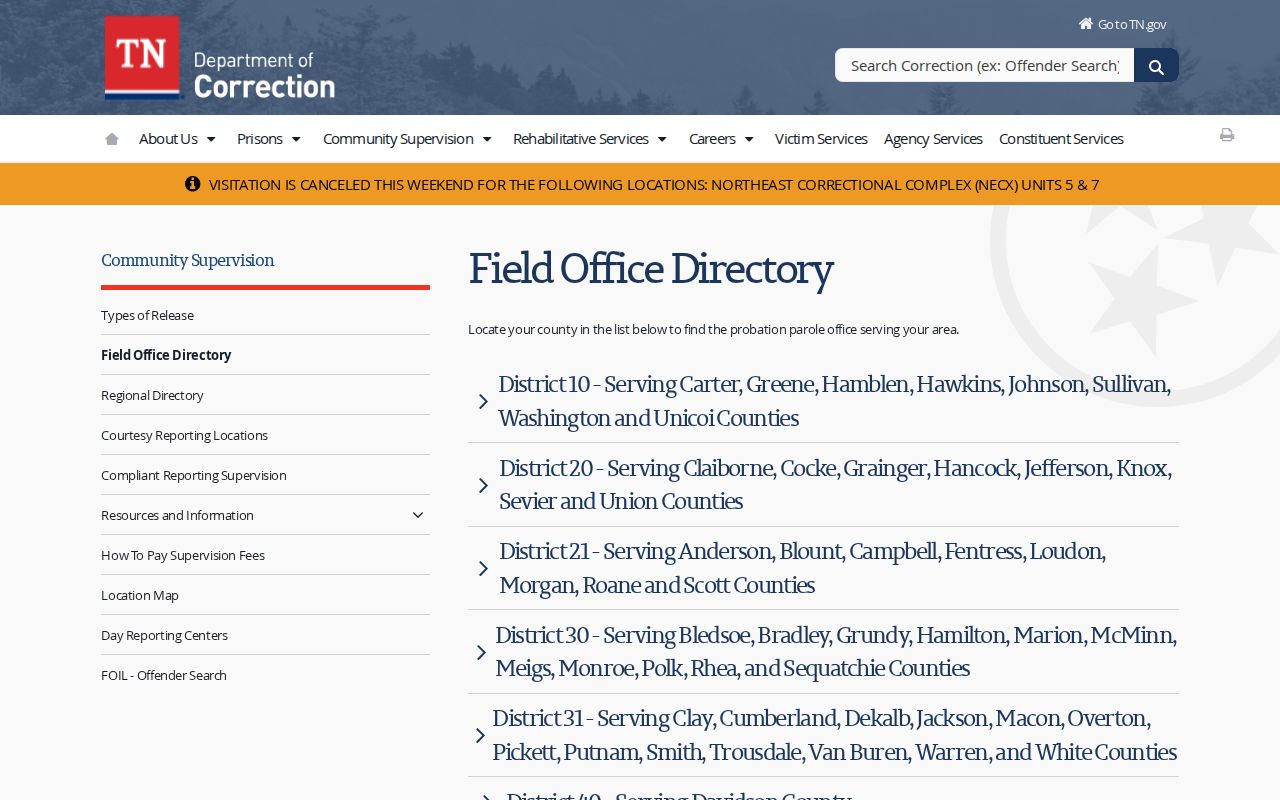
The listing confirms regional service through Chattanooga rather than a separate Bledsoe County field office.
Bledsoe Parole Hearing Records
The Board's hearing schedule is updated each Monday, or Tuesday after a Monday holiday. Schedules change. For a person at BCCX, locate the facility on the current state-prison schedule and match the name with the TDOC number. Since BCCX accepts men for diagnosis from across Tennessee, the hearing site does not prove that the criminal case began in Bledsoe County.
Hearing language matters. A grant hearing considers release. A preliminary revocation hearing addresses probable cause, while a final revocation hearing may revoke or reinstate parole. A custodial hearing can concern parole from one sentence to another. Pre-parole rescission can end a grant before release. Hearing officers make nonbinding recommendations, and Board members may adopt, change, or reject them.
No standalone live Board decisions database was identified. If FOIL does not settle the question, use the Board public-records request to seek the final vote, decision date, and hearing disposition. Give the full name and TDOC number. The schedule shows that a proceeding was planned. Only the later decision and release record show what occurred.
Board appeals are limited rather than a general second hearing. The official process cites Tennessee Code section 40-28-105(d)(11) and identifies grounds such as significant new information that was unavailable, substantiated misconduct, or a major procedural error. The request deadline described by the Board is no later than 45 days after the offender receives final-decision notice. Current rules should be checked for any individual case. An appeal filing also does not prove release, revocation, or discharge.
Note: Board schedule staff can be reached at 615-741-1150, and schedule requests may be sent to BD.HearingSchedules@tn.gov.
Bledsoe Supervision Violations and Warrants
Community supervision can include reporting, approved residence, treatment, travel, and offense-specific conditions, but the controlling rules are found in the person's order and supervision record. A claimed violation does not by itself prove that parole or probation was revoked. The process may produce a court warrant, Board revocation record, modified conditions, reinstatement, or another official outcome.
An absconder is not the same as a person who completed supervision. No Bledsoe-specific official sheriff absconder or warrant list was identified. A missed meeting also does not establish a warrant. Check the current FOIL status, ask District 30 about the correct record channel, and obtain the Board revocation decision or court warrant when one exists. If county jail custody begins after an alleged violation, the jail register shows that custody event, not the final supervision result.
TN SAVIN and VINELink report custody events such as release and transfer. They are not public probation compliance logs. A VINE alert may help track a new custody change, but it should be checked against the agency that created the event.
If an alleged parole violation produces new confinement, distinguish the new custody event from the final Board outcome. Preliminary revocation proceedings address probable cause. A later final hearing can revoke or reinstate parole. Probation violations instead return to the sentencing court's authority. That division explains why the correct proof may be a Board record in one case and a court order in another, even though TDOC supervises both people in the community.
Bledsoe County Supervision Discharge
Release from prison and discharge from supervision are separate dates. A person may leave prison on parole yet remain under TDOC supervision until the sentence or supervision term ends. Probation likewise continues until the sentence is completed or a court enters another lawful order. FOIL may later show an inactive status, but that word alone does not explain the reason or exact date.
For parole, combine FOIL release information, the Board's final action, and the TDOC supervision record. For probation, pair FOIL with the judgment and probation order from the sentencing court. If historical proof is needed, a focused TDOC archived-record request can seek the final custody status and actual discharge documentation. The public record may be subject to redaction or lawful limits.
Do not confuse discharge with a transfer, an approved release plan, or a hearing outcome. Each marks a different point. The strongest conclusion identifies who held or supervised the person, the official status, the effective date, and the record that created the change.